Monday, April 1, 2019

LaGuardia Wikipedia Translatathon Program for April 4 and April 5


--Food will be provided both days-- 

Thursday, April 4th 4:00-8:00pm

At all hours: Wikipedia editing and translating (E-111)

4:30pm: Wikipedia Principles and ‘How To’ Introduction on editing Wikipedia for new editors (E-106)
6:00pm: Wikipedia Principles and ‘How To’ Introduction on editing Wikipedia for new editors (E-106)
7:00pm: Wikimedia NYC Lightning Talk (E-111)

Friday, April 5th 11:00am - 5:00 pm

At all hours: Wikipedia editing and translating (E-111)

11:30am: Wikipedia Principles and ‘How To’ Introduction on editing Wikipedia for new editors (E-106)
12:00pm: #RadicalLegacyBuilding: Historically Undervalued Languages & Wikipedia as a Tool for Language Advocacy. Presentation by Wynnie Lamour (E-111).
2:00pm: How the Internet Helps Keep Languages Alive. Presentation by Daniel Bogre Udell of WikiTongues (E-111)
3:00pm: Wikipedia Principles and ‘How To’ Introduction on editing Wikipedia for new editors (E-106)
4:30pm: Beyond Wikipedia is...Wikidata. Presentation by Loren Koenig (E-111)

For more details and to register (you will need to get a Wikipedia account): https://meta.wikimedia.org/wiki/Translat-a-thon/NYC/2019

Note: Dr. X's students who participate in the translatathon will earn one token to use as described in the syllabus.

4/1: Psychological Effects of the Net and Web

Class

1. Report on Turkle

2. Watching and reflecting
a. Alter, “Why our screens make us less happy.” https://www.ted.com/talks/adam_alter_why_our_screens_make_us_less_happy

b. Harris, “How A Handful of Tech Companies Control Billions of Minds Every Day.” https://www.ted.com/talks/tristan_harris_the_manipulative_tricks_tech_companies_use_to_capture_your_attention?language=en

For next class
Read and take notes for Orwell, Nineteen Eighty-Four. Chapter 1

Wednesday, March 27, 2019

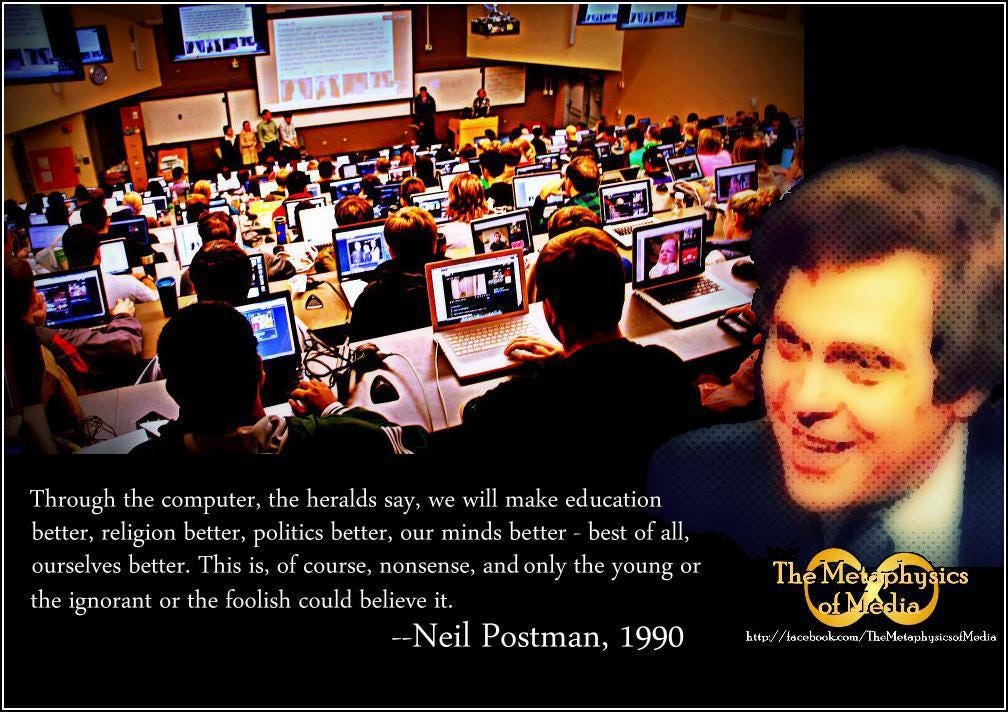
3/27: Neil Postman's “Five Things We Need to Know about Technological Change.”


If students get a sound education in the history, social effects and psychological biases of technology, they may grow to be adults who use technology rather than be used by it.
   --Neil Postman

EQ: What are the cultural and personal effects of the Internet and Web?

Class

1. Report on Postman

2. Writing practice: How W1, W2, W3, and W4 can be used in introductory and signal phrases.

3. Wikipedia editing, continued

For next class
For next Wednesday 
Be ready to turn in your Reading Journal with annotations of all readings up to, at least, Postman. 

Wednesday, March 20, 2019

3/20-3/25: Wikipedia Workshop

Black Lunch Table's Wikipedia Editathon for We Wanted A Revolution: Black Radical Women 1965-85 at the Brooklyn Museum
By Blacklunchtable - Own work, CC BY-SA 4.0
 https://commons.wikimedia.org/w/index.php?curid=60878028


Class
  1. Joining the Wikipedia Translatathon 2019 Project. Project Event page here:  https://meta.wikimedia.org/wiki/Translat-a-thon/NYC/2019
  2. Discussing, voting, and choosing what to edit and create


Wednesday, March 13, 2019

Vote--Should I submit a proposal for the symposium today? 

YES: some of us will present on our Wikipedia work and what came out of it; the rest will attend part of the symposium
Pros: Joining the college community to learn about Latinx culture; getting a college presentation as part of your resume
Cons: will move schedule one class down; one less class to use for workshopping papers

NO: We have class as usual on Monday, April 8


3/13: How the World Wide Web Has Changed


Class

From DarkNet Terminology: Definitions of the DarkNet, the Dark Web, and the Deep Web


2. Report on the ACLU. Watch: Burger King/Whopper Neutrality: https://www.youtube.com/watch?v=ltzy5vRmN8Q

3. Define with your partner: What is the web? How does it work?

Example:

TCP/IP:  Transmission Control Protocol (TCP) and Internet Protocol (IP) are two distinct computer network agreed-upon set of rules that are commonly used together. When two computers follow the same protocols, they can understand each other and exchange data.
  • Transmission Control Protocol divides a message or file into packets that are transmitted over the internet and then reassembled when they reach their destination. 
  • Internet Protocol is responsible for the address of each packet so it is sent to the correct destination.
Your Turn: What is.....?
  • Uniform Resource Locator (URL)
  • hyperlink(ing)
  • a browser
  • a search engine
  • a server and a client
  • a protocol
  • a path
  • an IP address
  • the cloud
4. Comprehend: The Types of Web:
5. Comprehend: The Development of the Web
  • Web 1.0: Static, hyperlinked pages such as Internet Shakespeare Editions
  • Web 2.0: Interactive pages, such as Wikipedia, Facebook, Amazon.com
  • In the works: Web 3.0: Categorized web that "learns" about itself and its users (also called Semantic Web)
    6. Overview: The Uses and Values of the Internet/World Wide Web as Designed by Their Creators

    7. Berners-Lee, “The next web.” Notice the date!: 2009.   https://www.ted.com/talks/tim_berners_lee_on_the_next_web?language=en#t-278796


    For next class


    Monday, March 11, 2019

    3/11: History and Definition of the Internet and the World Wide Web

    Essential question:
    • How does the online world work and how has it changed since its inception?
    Class

    The Internet
    Reports on Rosenzweig: The 7Ws.

    The World Wide Web
    Watch: Camp, “What is the World Wide Web?” https://ed.ted.com/lessons/what-is-the-world-wide-web-twila-camp

    Listen/ Read/Annotate/Discuss: Berners-Lee, “How Did The World Wide Web Start?” (TED Radio Hour podcast and transcript) https://www.npr.org/2015/10/23/449180060/how-did-the-world-wide-web-start


    For next class
    Read/Listen

     1. “How the Web Works-In One Easy Lesson.” http://mkcohen.com/how-the-web-works-in-one-easy-lesson

    2. Bartlett, “What Goes On In The Secrecy of The Dark Web?” (TED Radio Hour podcast and transcript) https://www.npr.org/2017/12/15/570797404/jamie-bartlett-what-goes-on-in-the-secrecy-of-the-dark-web

    3. Definitions: Web 2.0, Web 3.0, Internet of Things


    4. ACLU. “Net Neutrality”